Recently, it seems as if every other post on my feed is a gift guide or sale alert! While I appreciate the ease of having options and deals all put together in one place for me, as so often happens on social media, I just don’t feel like it applies to us.
I always appreciate the questions from friends and family around holidays and birthdays regarding what to get the kids, and Y specifically. I will admit, it can get overwhelming. There is a lot to consider, both on Y’s end and for our friends and family as well. Gifts he’d prefer could be harder to locate, require ordering well in advance, or may not really seem like a gift in the traditional sense (of course this is a wonderful issue to have and I’m so grateful for the love and generosity of our circle!). If you find yourself in a similar situation, whether as someone looking to purchase a gift or someone looking for ideas to share with family, I’ve put together a few tips and ideas in an attempt to make gifting as stress-free and appropriate as possible! These are all aspects I take into consideration and I believe can be applied fairly generally. I hope this provides clarity and is insightful and helps to make this season a little less stressful!
5 Things To Keep In Mind:
Age / Popularity:
Many websites will highlight the best gifts for a certain age group or the hottest and most sought after toys of the year. While I appreciate the guidance this provides, it isn’t always applicable to Y. His interests remain fairly consistent and don’t necessarily change with the latest movie or series. The age range advertised does not reflect a wide developmental spectrum and is better understood as appropriate for children who are neurotypical and of that age. A gift labelled for a seven-year-old may not be accessible for a variety of reasons. Of course, this is all very personal and if the family or the recipient think it may work, then by all means, go for it!
Safety Considerations:
Please ask if there are any safety concerns that should be taken into consideration. You may see an item that you think is perfect, but if the recipient is currently in a stage where they are mouthing things / bringing everything to their mouth, for instance, smaller toys or things with batteries or magnets could pose a serious, elevated risk.
How You Wrap The Gift:
Accessibility doesn’t apply solely to the gift that you choose! I’ll admit, I love seeing all the gifts wrapped up in coordinating wrapping paper, piled lovingly, waiting to be excitedly torn into! For years I thought Y would love the act of ripping off the wrapping paper, with all it’s sensory and tactile fun! That wasn’t the case, and if anything, it just caused a lot of frustration. We’d help by ripping a little corner to help him start off and then guiding him to do the rest, but by the time he had removed a sufficient amount, he was no longer interested and re-directing him back to the actual gift could be difficult. The past few years, I’ve simply put his gift into gift bags with very little tissue paper or distractions and it has made all the difference! He happily pulls out each item and it’s less frustrating! Consider the developmental ability of the recipient and how they’re best able to access the gift in a way that is meaningful and enjoyable to them!
Expectations:
On that note, it’s so important to do what you can to make the experience memorable and enjoyable for the recipient. I’ll be the first to say that I love seeing reactions when gifts are being opened! The excitement is tangible and I can’t help but explain what it is, or point out fun features, and of course, hope that the reaction received is a favourable one that reflects my anticipation. Nothing compares to seeing Y light up, knowing that he feels seen and heard, that we gave him something he truly loves or enjoys. The way that he shows this is not always what others may expect. One year he ran to his room with the first item he opened, before opening any other gifts, and went to play right away! Another year, he matched the items while still in their boxes (matching is something he absolutely loves to do!) and didn’t want us to open them yet, as he smiled and concentrated on lining up the boxes. Of course, there have also been times he’s put down the item and has gone back to playing with whatever he was holding before. Giving him the space to experience and explore what he’s been given is so important and I always keep in mind that the respect shown to him in that moment is more important than the gift or our own need for acknowledgment.
Consider the Atmosphere / Environment:
Finally, building off of the previous point, as much as I love to see the reactions of the recipient, sometimes it’s just not the best option. Birthday or holiday parties can be a very overwhelming sensory experience. Between the crowd, multiple conversations taking place, lights, sounds, music, people walking around / moving from one area to another, smells of food and perfume etc., it’s A LOT. Having to be the center of attention, with everyone watching, as gifts are opened can just be too much. Taking the gift home or going to a quiet space alone to open it may be more meaningful and appropriate for the recipient. This doesn’t reflect any selfish, “anti-social,” or negative sentiment at all, it simply is what is best for the individual and if that is the case, respecting it and everything I’ve mentioned in the points above, is even greater than any physical gift!
I’ll be sharing Part 2 shortly, with gift ideas that are accessible in terms of developmental considerations as well as at a variety of price points! If you don’t want to miss it, make sure to subscribe to the blog or follow along at @ItsyBitsyBalebusta!
Category: autism
-

Gifting Guide (Part 1)
-
Let’s Be Real
In recent years, there has been a beautiful push to create an environment where moms feel safe sharing that things are hard. Across Facebook and Instagram, photos and stories of moms crying in a locked bathroom or sitting in their car, allowing themselves to feel all of their emotions, are more and more common. The resounding sentiment has been that it’s okay to be honest and truthful about the beautiful, chaotic, exhausting, and absolutely incredible experience of raising children. Not for a second is anyone saying they aren’t grateful, that they don’t recognize others would and often are doing everything they can to become a parent themselves, and that it isn’t a burden but a blessing.
In recent years, you don’t have to look hard to find a niche where you can find other moms making similar choices, whether it comes to feeding, sleep, or more! Exhausted mom memes and relatable reels abound. Every day, the idea that it’s okay to be honest about our different motherhood experiences grows and it’s both wonderful and necessary. The knowledge that always parading around shouting #blessed is not realistic is well overdue.But (because this is obviously leading somewhere, right?) it doesn’t seem to extend to every mom.
As a mother of a child with a disability, I don’t feel like this applies to me. I feel like I need to always be on, never complain, accept and do and keep going and going and going, and never once say that this is HARD. I’ve seen other mothers of autistic children be torn apart in comment sections when they’ve attempted to breach the line between being positive and an unbreakable caregiver who only sees the good, and an honest mom who’s tired and scared and defeated. Who’s sad and who feels guilty about that sadness, and more upset at herself over it than anyone else could ever be with her (try as they might, in those dreaded comment sections).
I’m feeling conflicted about sharing here when it comes to autism. On the one hand, I don’t feel right sharing about the more difficult moments, as I haven’t quite figured out how to share from my perspective and experience as a mother without including the details that are personal and belong to my son. On the other hand, looking over my feed, I hate that any parent of an autistic individual would come across these little squares and see outings and highlights and the many moments of joy we’re blessed with, and not see the whole picture either. The reality is that this is a rollercoaster. Just as there are highs, there are also lows, and right now, in this space, those lows look like silence. They look like days without posts or stories, weeks without meaningful words to share. I want this space to be about community and empowerment. I want it to be a visual journal where I share what I’m learning (often as I’m learning it) and how our family is really not so different. How my journey through motherhood is still accessible and relatable. It’s about advocacy and AAC and autism. About books and family adventures and all the little things that come together to form our day-to-day. To celebrate the achievements without acknowledging the struggles seems deceitful, but to share the struggles seems questionable too.There is so much isolation when you have a child with a diagnosis, that you really start to believe no one gets it. But how could they when you don’t share? The pages that openly discuss elopement and sensory struggles among other topics, bring me such comfort and peace, knowing there are other parents navigating the same challenges. A place where we can share referrals or programs, tips that have worked or simply be there for one another. I want to provide the same here, but how do I do that in a way that’s respectful to Y, but still acknowledges my experience as well?
Over the past few months, I’ve shared countless family adventures and books I’ve been reading. I’ve shared my favourite nail polish colours and how I’ve been refreshing the arrangement of our play area daily. I’ve shared mugs and memes, toddler escapades, and even managed a post on AAC before #AACAwarenessMonth was up.
Know what I haven’t shared? New challenges we’re facing that keep me up at night. I didn’t think it was anyone’s business, and worse, that I would be attacked for complaining when others have it so much worse. Or how about, how dare I say it’s hard on me when it’s a million times harder on Y?
I haven’t shared that.
But maybe it’s time to share the harder moments too. How can I advocate for better provincial support for my child when one look at the life I share makes it look like we don’t need that much help at all? How can I reach out to other parents on their pages when they share their experiences and say that I can relate or that I appreciate their honesty and vulnerability, when if they look at my page they’ll essentially see one large #blessed billboard?
I’m still not sure how to approach this, but I know that I need to. I’m still not sure how much I’ll share but I know it won’t ever be from Y’s perspective – simply because I can’t and I personally feel it’s wrong to even attempt to. My page won’t suddenly become about hardship and struggle, because that isn’t truthful either. We are so blessed and there is so much good every single moment of every single day, even when it’s hard to see. What does this mean? It means I’m going to start sharing more about elopement, in the hopes of increasing awareness of the concept and hopefully to feel less isolated in this challenge and learn together. I’m going to start sharing lessons we’ve learned when we’ve encountered challenges out and about – lessons that wouldn’t make sense unless you also know what exactly the difficulty was. I have spent the last 7 years doing everything I can to ensure Y has every single opportunity, service, and door open to him. That he is never lacking and that whatever he needs to meet challenges or thrive is offered to him, as much as possible. That he is surrounded by knowledgeable, loving, supportive, and capable people, who have his best interests at the forefront of their actions and whose ability to help him navigate challenges, reach goals, and thrive is excellent. I will continue to do this and more for him, every day of my life. It’s just time that I start to do the same for myself as well.
-

5 Things I Wish I’d Known About AAC As A Parent
October is AAC Awareness Month! Earlier this month, I shared 5 accounts that go above and beyond when advocating regarding AAC (and all things speech!) from a professional, insightful perspective. Although AAC is something we’ve been learning, exploring, and incorporating into Y’s life for the last five-or-so years, we are still relatively new to this arena. If you’re looking to deepen your understanding of AAC from a foundational standpoint, I encourage you to check out the five accounts linked above, where you’ll find pages filled with guidance, support, and accessible educational information!
I am not a speech therapist. I’m not an expert on all things AAC or how to implement it, or where to even begin. Every individual is different, every journey is unique, and the very ability to access the resources to delve into this varies so much from person to person, therapist to therapist, school to school, city to city, etc.
So what can I offer? Why bother sharing in the first place? Although it may not be from the perspective of someone who uses AAC or a professional, I know what I myself have gained, learning from other parents and caregivers, and the unique position that we have. When it comes to understanding the journey to accessing a device or being a parent/caregiver advocating, learning, and training to support your loved one, I feel that I do have something to add to the conversation.
Where to start? I have SO much to say on this topic that I barely know where to begin. Over the last 5 years, Y has trialed a variety of different types of AAC, both aided (requires a physical tool) and unaided (does not require one). He has worked on sign language, gestures, and body language. He has navigated choice cards, communication boards, and PECs (I have a very love/hate relationship with PECs). Today, he primarily uses the LAMP program on his iPad to communicate. AAC is something that is a part of the fabric of our home and something that our younger children have been exposed to since birth. E has never not known a home filled with PECs or LAMP. To our kids, learning to communicate via different forms of AAC is as common a concept as learning a new language.
When I thought of what I’d most like to share in honour of AAC Awareness Month this year, I decided to focus on one topic. I cannot tell you what it’s like to sit for hours a day learning to navigate AAC from the perspective of my autistic son. I won’t even try to, that is not my place and not my story. My taking the time to practice to use the device and familiarize myself with it after he goes to sleep is not at all the same as his learning to use it to communicate. Having said that, because of our experience, I have learned a few very important things I wish I had known sooner. I hope that by sharing these 5 lessons with you today, it saves you the detours we’ve made along this journey and gives you a little more encouragement and strength as you navigate it all!
First and foremost – Your Child Comes FIRST. I know this is a given – of course your child comes first! But what does that actually mean? For over two and a half years, I advocated to stop PECs and move on to another form of AAC. I had had enough. Y had had enough. There were PECS taped to every surface of our home and rather than use them to communicate, he’d rip them from the wall and match them. He’d hand us any PEC and stare at us expecting what we’d come to understand as water or a snack while we stared down at a PEC of a pillow. We carried a binder with us everywhere and then he’d suddenly start eating a new food and we didn’t have a PEC he could use to communicate that to us and it would take days to get it made and added to his book, at which point he had already often lost interest. I would spend hours upon hours photographing, re-sizing, printing, and preparing PECs for him that would be destroyed in a day. Listen, I know there’s a value to the system. He did come to use them to communicate. But we spent over two years on this and all along the way I know he was telling me that this just wasn’t for him. And I would take that certainty, walk into meetings or send off emails, and always be told to give it another month. To try a different size or format, or to even take a break from it all! Your child comes first! I wish I had been stronger and just said no. I wish I had demanded an alternative rather than continue to stress him out when he was so clearly telling me that this wasn’t working. When the world shut down in March 2020, I got a phone call that Y had finally come off of the waitlist for an AAC program we had registered for, ages before. I sincerely feel that this could not have been timed better and that it happened when it was supposed to happen. At home, with only my husband and I and one incredible IT, we started to implement a trial program. There was no school, no one else to navigate the day-by-day, and the four of us – myself and my husband, the IT, and Y, together with a team from the agency, embarked on LAMP. When I contacted his school about it again, I was told maybe he wasn’t ready for it. Why LAMP? They weren’t familiar with it and they suggested a different program that they were familiar with, one that other classmates used. Your child comes first!! Y was responding beautifully to LAMP and that’s what we stuck with. Not only did he successfully complete the trial and receive a device of his own, over a year later, while his skills are still emerging, he IS confidently using it to communicate.
This leads me to my next point – Find Your Team! I didn’t want to leave our original team. Despite the stress and constant need to advocate, I didn’t want to move Y from a place he was familiar and comfortable with, and where there were people who genuinely did care for him and had his best interests at heart. Eventually, we were left with no choice, and while I felt shattered, the most incredible thing happened. Pieces started to fall together so seamlessly. I couldn’t bring myself to tell anyone because it seemed so absolutely surreal. After our first intake meeting with our new team, I exited the zoom meeting and broke down sobbing. I turned to M and we realized that not once during the entire meeting did we have to even advocate. When I went in person to see the school and meet the staff, I brought along LAMP expecting to have to convince them to give it a shot. Not only did they excitedly embrace it, but not once did they ask if we’d consider anything else. They have worked non-stop to learn and implement and support Y with it, never once saying anything remotely negative about it. The speech therapist he works with is absolutely incredible. She is kind and patient, knowledgeable, and so incredibly sensitive. She has included us in every step and has immeasurably renewed my trust and confidence. Y loves her and lights up at the mention of her name, and honestly that’s saying it all! If you’re struggling with your team, you can find a new one. It’s not easy, it’s actually really hard and painful, and you’ll question yourself a million times, but it is not only worth it, it’s necessary. What works for one person, may not work for another, but when you find the right fit, it is absolutely life-changing.
In my experience advocating for Y, I’ve heard a lot of really diminishing comments from professionals. That implementing certain programs would be, “too abstract.” That I needed to be logical and reasonable. That I needed to just trust the professionals and step back. It wasn’t until we met our new team that I was introduced to the concept of “presuming competence.” This is a strength-based approach, where you assume that the individual is capable of learning, thinking, and understanding. Whereas I was once told that including items associated with Shabbos in his matching program was too abstract for him, the whole framework changed to – he knows what these items are, he can match them. Years ago, we were told previous head staff had attempted AAC with him, but his point wasn’t strong enough, he would get frustrated with the device, and he didn’t have the strength to hit the correct command. Not once did anyone mention a screen guard. It was all about what he couldn’t do. As soon as he had the right tools, he showed us in three weeks that he could use this device beautifully and again, a year later he continues to. I wish I had started out this journey from a strengths-based angle, rather than hearing that his point was off and feeling like this wasn’t going to be accessible to him after all.
Another important point – You Don’t Need To Master Anything To Move To A Different Format!!! I was always led to believe that before considering AAC he would have to “master PECs” and then we could start that conversation! Absolutely not! I know now that there are NO prerequisites to trying out a device! I try really hard not to fixate on the amount of stress, heartache, and time we could have saved had we known that. Everything happened when and how it was supposed to, but please do not feel that you/your child needs to prove themselves in order to be able to try this out! If a trial fails, try again, try a different format, find what works for your child, but do not feel like you need to master unaided AAC before moving to any form of aided AAC!!
Finally, and this is something that as a caregiver/parent I am asked most frequently – no, AAC will not prevent speech from emerging. In fact, speech isn’t even the goal! The goal is to effectively communicate! This is a much more nuanced/knowledge-based point, and I’d encourage you to check out professional AAC accounts for more information, but it was a point I felt needed to be said!
I hope that wherever you are in your journey, you are met with respect, sensitivity, and the presumption of competence. I hope that you feel confident in your advocacy and that breakthroughs and good days vastly outnumber the harder ones. I hope that communication is always effective and that it leads to growth and confidence, independence, and an ability to speak up for oneself and be heard, regardless of how! -
Autism Awareness Month 2020
Originally published on http://www.itsybitsybalebusta.com
04/2020
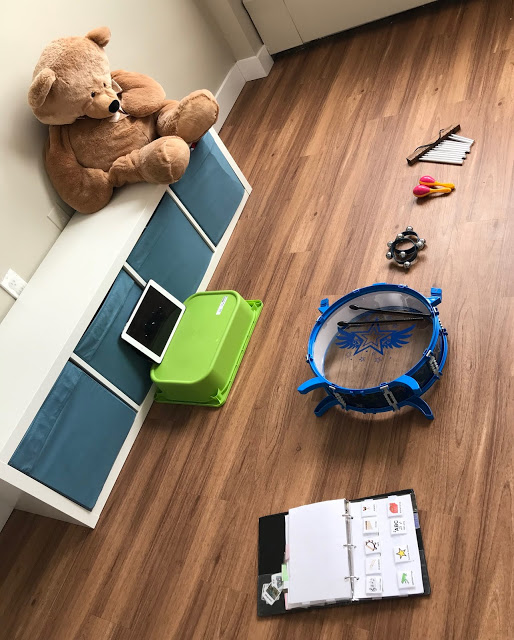
When online learning started in March, I shared on Instagram how I was having a hard time finding a reflection of our reality as I scrolled through my feed. Seven weeks later, it’s almost weird to feel like this is our norm. Mornings spent getting through showers, laying out uniforms, making lunches, updating communication books and filling up backpacks have been exchanged for a much slower pace. We’ve settled into our new routine which includes zoom sessions and tele-therapy. While N is able to (for the most part) sit and participate in virtual circle time and lessons with his class multiple times per day, the photo above is what online learning looks like for Y.For the past three years, he has received intensive therapy through the autism program offered in his school. When the school closures were announced, my fears of regression grew exponentially. Without the necessary consistency required of his program, consistency we had done everything to maintain for the last 3+ years, I couldn’t see how regression would be avoidable. While the last five years of this journey has thrown multiple learning curves my way, learning how to advocate through a pandemic has definitely been one of the most interesting. M & I are very involved in Y’s programming and with all aspects of his therapy. With the school closures, we didn’t just have to adapt to the pandemic version of homeschooling, supporting our three children under six through a chaotic and confusing time, working from home and navigating our way through Pesach, basic errands, groceries and more, we also suddenly became stand-in therapists. Together we developed our own “Get Y Ready For Pesach” program! We used techniques and strategies we had learned over the years and began to fade out chametz and prepare for a three-day yuntif (where routines would be further changed out of their norm than they already had been). I’m so proud to say our preparation and “program” was successful! Y’s resiliency and ability to adapt is astounding.
Now that school is back in session so to speak, the above photo is what e-learning looks like in our home. It just so happens that Autism Awareness Month fell during quarantine. While the phrase, “If you’ve met one person with autism, you’ve met one person with autism,” stands true, I feel like it’s important to share what learning right now may look like for families like ours.
Basically from birth, Y has always responded to music. Although he was colicky, over time, certain songs and sounds began to soothe him. Over this past summer, Y’s ability to communicate really began to pick up. We would frequently hear back from his team about how attentive he was during his group music sessions as well as how he’d participate and was more willing to put into practice different strategies he was learning in other areas specifically during this therapy. M & I spoke about it and although we were concerned with how full his schedule already was, we decided to go ahead and add music therapy. I was very clear that I didn’t want this to be work for him. I didn’t want him to have a ton of expectations and I didn’t want the other therapies to overtly partner here, as they did in other areas. I wanted this to be a space where he could enjoy music and where it could soothe him and help him continue to put into practice everything he had been learning naturally and, for the most part, independently (or at least more so than we had seen in other forms of therapy). I wanted him to know that we had “heard” him, so to speak, and understood that music had an impact on him and that we wanted to embrace and encourage it!
I could not have anticipated the results we’ve seen. I’ve learned (and frequently been told) to remain realistic. It’s not a phrase I like, but it is something I’ve come to at least partially understand. I truly believe Y is capable of everything and anything and will always advocate as
such. When it came to music therapy I had two motives – I wanted him to be happy and feel heard. N can tell us that he likes certain activities and expresses his hobbies and interests clearly. I strongly felt that Y was attempting to do the same through his engagement with music and I wanted him to know we recognized that. Months later, not only does he absolutely love these sessions, but the following three words speak for themselves – he is thriving.
Quarantine has been HARD, don’t get me wrong. When you go from 36 hours of professional intensive therapy a week to almost nothing for 5+ weeks, it’s definitely a shock and challenge. Behaviours that had been addressed begin to emerge again and the fear of regression hangs overhead like an ominous cloud. Given all that, without quarantine I would never have attended or participated in a music therapy session the way I’ve been able to these past few weeks. It may seem an odd thing to be grateful for, but I am nonetheless.
We are beyond blessed to have an incredible therapist working with Y. Her patience, sensitivity, encouragement, warmth, and undeniable skill are extraordinary. Our family has known and loved her for years, but working with her directly through these sessions (and through a pandemic) has only further solidified how in awe we are of her. She has not only supported Y these past few weeks, she has provided me with endless amounts of hope, encouragement and kindness. I have cried during more than one session. I have been completely amazed at how motivating music is for my son. How through it he attempts to form words, how he is able to follow instructions, understand expectations, and participate appropriately and meaningfully. How he doesn’t want it to end and will work even harder those last few minutes to extend the session, even attempting to verbalize “more”. How he gets past the difficulty of working virtually and will connect with his music therapist through a screen. How he listens to her and will look right at her on that screen. How he has the freedom to make choices and guide the session through selection of instrument or song. I have watched my son flourish and thrive during these sessions.
I would be lying if I said it was without challenges. There are moments that are more difficult than others, but on the whole, it’s an undeniably positive experience for him and one which has effects that filter into so many other areas. Because of these sessions I know he understands his visuals, he knows that he is able to make choices and be heard through using them and he puts into practice taking turns, following instructions, understanding expectations and so much more!
Having Autism Awareness Month fall during quarantine this year highlighted so much for me personally. Regardless of the fact that we’ve been helping our son navigate this journey for the last 5 years, being able to see his resilience has been inspiring and has taught me so much. Being able to attend his virtual therapy sessions has been so eye opening, both in terms of how hard he works and how much prouder I am of him and every single one of his results, seeing the effort and determination first hand. Usually I feel like this month is reserved for sharing awareness with friends, family and across social media, but given the circumstances this year, I’m the one who, over the past month, has gained the most awareness in so many ways – ways that I hope will better shape the way I not only relate to my son but also to his therapy going forward! It’s one thing to be on top of the therapy and communicate with the team, attend meetings, request and view data, adjust programming here and there or attend parent training or host in-home sessions. It’s something else altogether to help carry out a session, to witness his resilience, determination, and ability to adapt and work through regardless of the chaos and upheaval to his routine, schedule and structure. Each day I say I couldn’t be more proud, but that’s quickly disproved the next day as my pride only continues to grow! Virtual learning is by no means easy for our family, but we’re adapting where we can, advocating for alternatives where we can’t, and learning more about each other and our strengths than ever before. And while it’s not the Autism Awareness post I was planning to write this year, it couldn’t be more fitting. Potential, capability and resiliency through determination are three concepts that should be synonymous with our son’s diagnosis and, if nothing else, I hope that is what you’re able to take from this post and what I’ve shared today!
 victoriarosenberg.com