Category: Uncategorized

  • Glen Stewart Ravine

    Glen Stewart Ravine

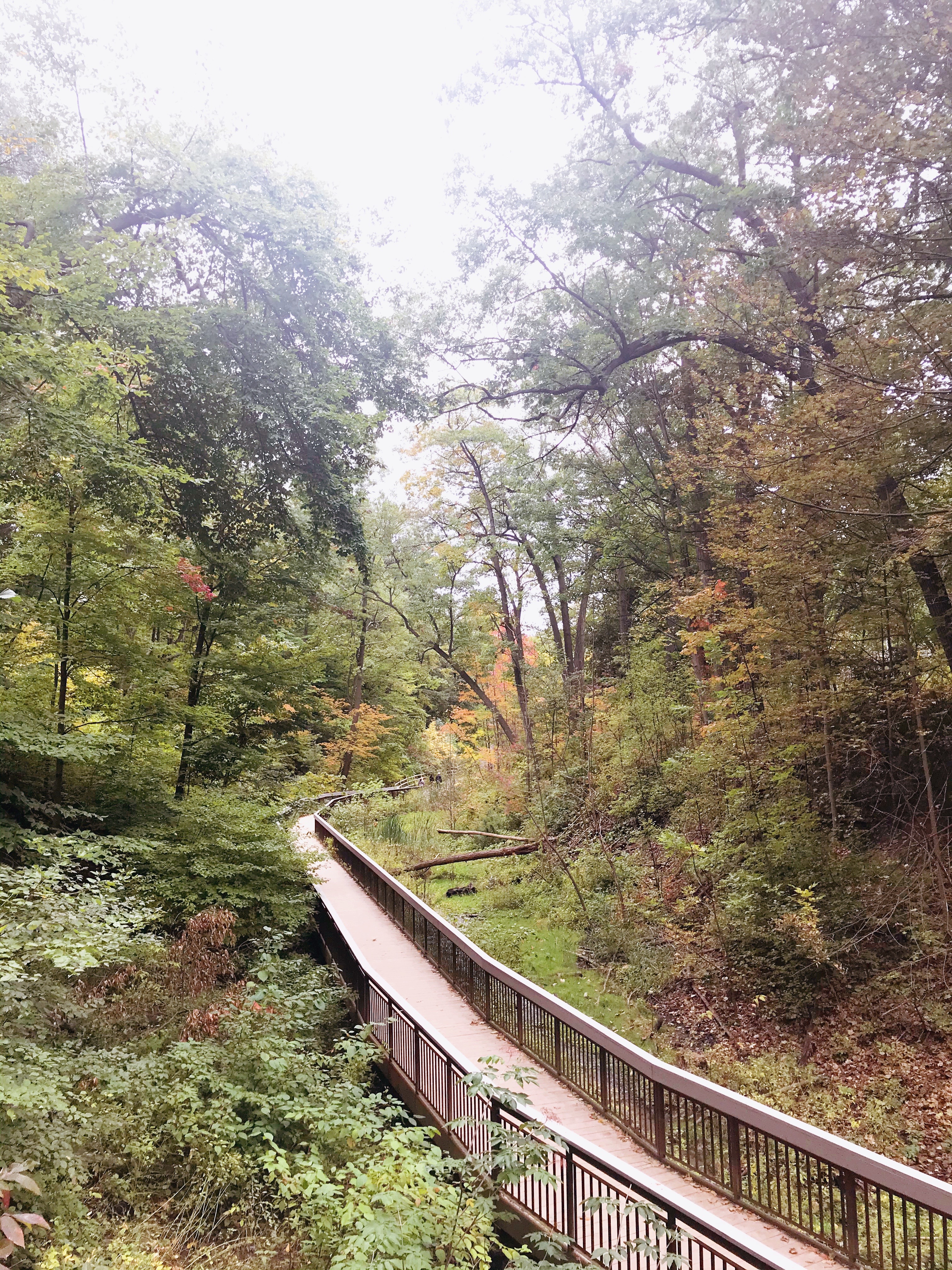
    We absolutely loved exploring Glen Stewart Ravine! Seemingly tucked within the side streets in the Beaches, the walk along the boardwalk through the brush is peaceful and stunning. There is something for everyone! If you’re looking for a fairly quick trail on even terrain, sticking to the boardwalk is your best bet and is a beautiful experience. If climbing (tons of) stairs is more your thing, then there are a few staircases scattered throughout the trail that provide alternate breathtaking views of the ravine, while also leading you out to the street where there are shops and restaurants to explore. There’s also rougher terrain, if you’re interested in a more demanding hike, where you’re able to get closer to streams and nature!

    Note:
    Below, I’ll address different elements that I take into consideration when planning, in the hopes of clarifying any accessibility or suitability questions you may have as you plan your visit! These are all based on our personal experience (our oldest son is autistic and non-verbal, and we are a family of 5 with a 7-year-old, 6-year-old and 2-year-old). I would suggest doing a quick search to ensure availability before heading out to avoid any disappointment (especially with changing health protocols, potential grounds upkeep, events, etc).

    Address
    351 Glen Manor Drive (see note below)

    Parking
    We park on Glen Manor Drive E. There is ample street parking along side streets, however this spot, specifically, is near an entrance to the trail that is more accessible, whereas other entrance points involve plenty of stairs.

    Terrain/Accessibility
    The first time we visited we brought a stroller for E. After about 15 minutes, we took it back to the car and set out again on foot. There is a somewhat uneven sandy/gravel entrance that leads to a boardwalk that is fairly wide and accessible, but if you’re looking to explore off of that path, the terrain is very difficult. There are rocks, exposed roots, brush and uneven ground that makes it difficult to navigate. There are also a variety of staircases throughout the trail, however, after climbing them, we realized they only lead to other side streets surrounding the park and other than alternate views of the ravine, rather than any other trails or such. I’ve included photos in the gallery below, to give you an idea of what the terrain is like, both on the boardwalk and off!

    Quiet Spots
    We found the whole outing very quiet and not overly stimulating or overwhelming in terms of a sensory experience. You can’t really hear the traffic or any other city sounds, and other than the rustling of the trees and birds, it was very peaceful. There are benches occasionally positioned throughout the trail, if you need to take a moment to stop and re-group. There is also plenty of shade and even on a hot summer day, it didn’t feel stifling.

    Size of Location/ Busyness
    We have visited early in the morning and mid-afternoon, and neither time were busy. There was ample space to explore and even though the boardwalk is somewhat narrow, it didn’t feel crowded. If you’re only sticking to the boardwalk, a half-hour should give you more than enough time, making it a great outing if you’re looking for something that isn’t intense and can be enjoyed in a fairly short amount of time, without getting too overwhelmed. The first time we visited, Y had a difficult time regulating during the walk, but managed to complete the entire boardwalk as well as a part of the rougher terrain trail, before he needed to head back to the car.

    Variety of Activities

    The walk along the boardwalk is very peaceful, as you’re surrounded by brush and the sounds of streams, rustling trees, and birds. Other than locals going for walks, the main activity seemed to be jogging and dog walking along the trails. We visited in both the summer and the fall, and the colours of the changing leaves in the fall were spectacular!

    Cost
    There is no cost to visit, including free street parking nearby.

    Other helpful links in this series:
    Summer Adventures & Accessibility!
    What We Consider When Planning An Outing
    Guild Park and Gardens

  • Guild Park and Gardens
    Guild Park and Gardens

    “…where art meets nature.”

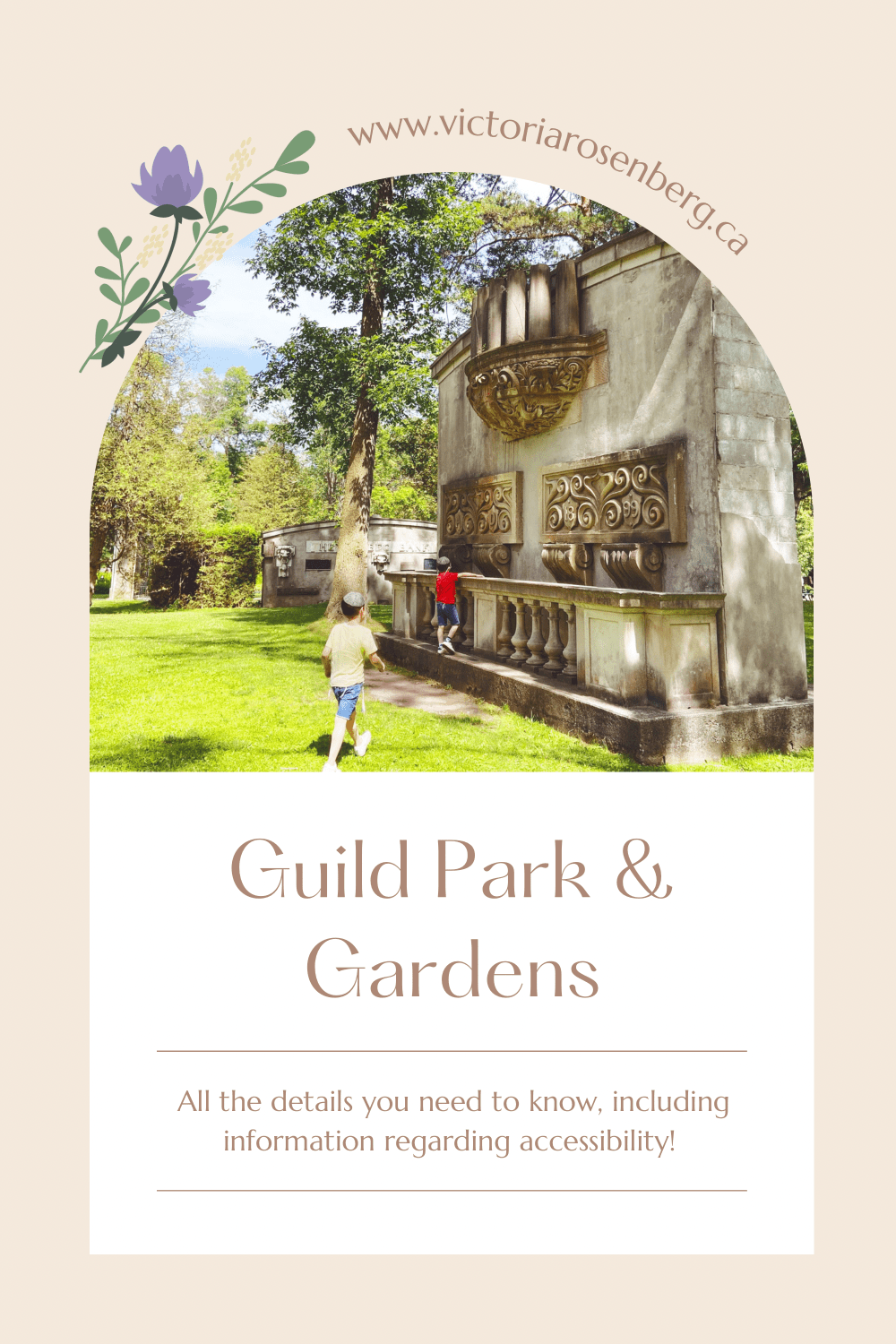
    There is no better way to describe Guild Park and Gardens. With each step you take through the grounds, you simultaneously feel like you’ve been transported to a secret garden in the middle of an otherwise bustling city as well as feeling like you’ve stepped back in time, surrounded by architecture and features that are more reminiscent of Europe and the Mediterranean, than Toronto.

    We visited the park for the first time a couple of weeks ago as one of our after-school adventures. The kids absolutely loved it! They immediately set about exploring the different structures and installations. They were so inquisitive and curious and it was one of the first times they were able to touch and see architecture of this type, firsthand. In a city where heritage buildings push the limits to incorporate modern elements (take, for instance, the ROM), it was breathtaking to see a place where structures were recovered, preserved, and re-assembled to their original glory, albeit in a completely different context.

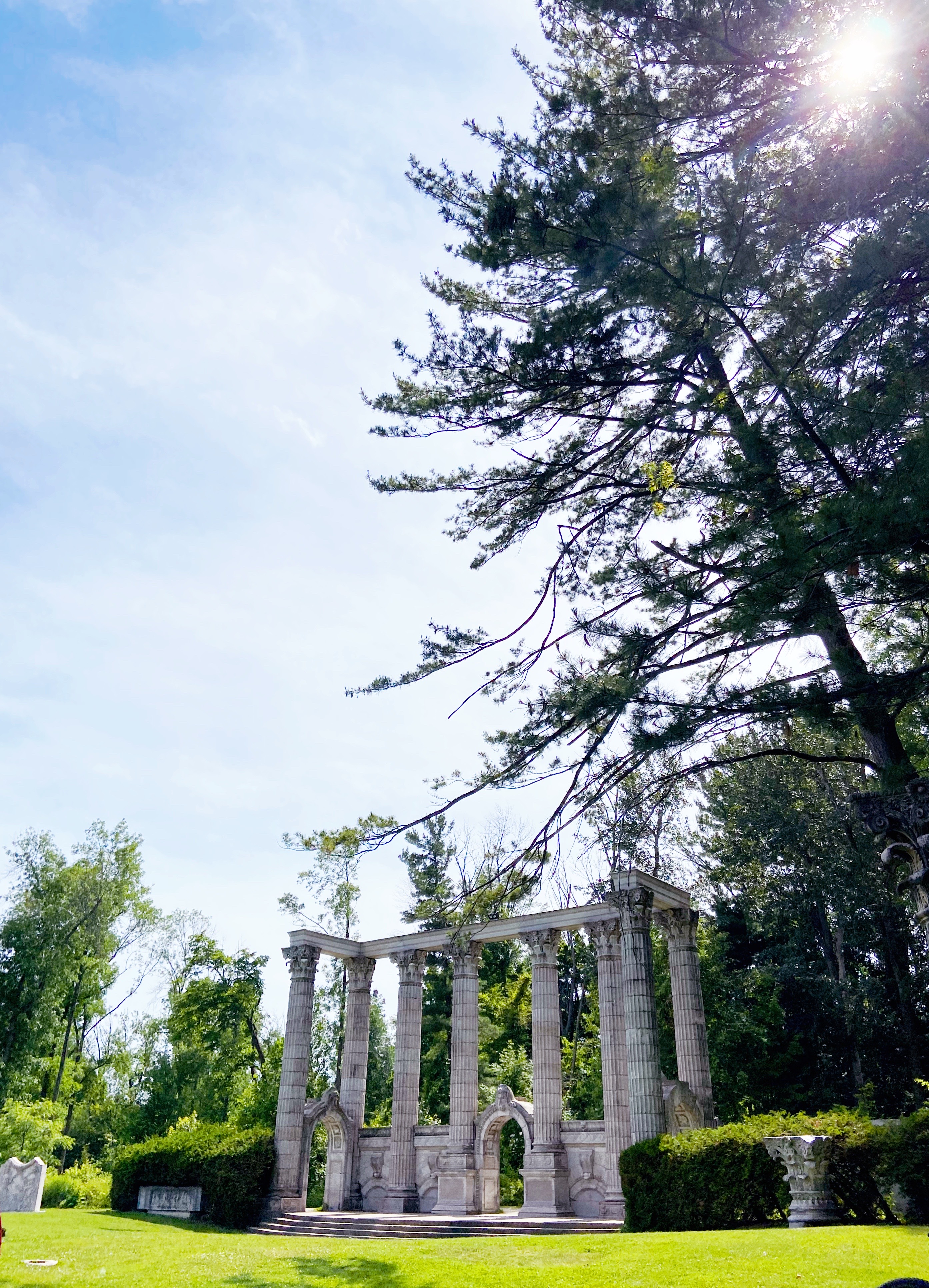
    The main feature is unquestionably the theater in the center of the park. As the website explains, “eight Corinthian columns from the Bank of Toronto at King and Bay Streets were re-assembled to build Canada’s only Greek Theatre.” While it was definitely worth spending the time exploring, there is so much else to see as well (see the gallery below!). Like this structure, the others are also re-assembled from different buildings, ranging from those of the Toronto Star to an old brewery. The way in which the original context has been changed to create such a majestic and breathtaking garden, is incredible!

    Below I’ll address different elements that I take into consideration when planning, in the hopes of clarifying any accessibility or suitability questions you may have as you plan your visit! These are all based on our personal experience (our oldest son is autistic and non-verbal, and we are a family of 5 with a 7 year old, 6 year old and 2 year old). I would suggest doing a quick search to ensure availability before heading out to avoid any disappointment (especially with changing health protocols, potential grounds upkeep, events, etc).

    Address
    201 Guildwood Pkwy.

    Parking
    There was plenty of parking available, at no cost.

    Terrain/Accessibility
    We found that all areas were accessible and where there were stairs, there were grassy hills nearby that could be used as an alternative. For the most part, the paths consisted of fine gravel or grass. The Greek Theatre itself, could be accessed from behind, if the stairs are not an option, still allowing for the ability to explore the stage closely. I would suggest bringing insect repellent, since we did leave with a few mosquito bites!

    Quiet Spots
    There’s a lookout area that faces the lake that is beautiful and peaceful, if a space to regulate or take a small break is required. Truthfully, when we visited (mid-week, early evening) it was very quiet and not overwhelming. Everything is spaced out and it feels very open and airy.

    Size of Location/ Busyness
    There was ample grass and space for the kids to run around and play when they needed a break. It’s a fairly large park and E did request to be carried after a little while – if you have a young child, I’d recommend a stroller. Having said that, in about an hour we had explored the different structures, spending a bit of time at each. As I mentioned before, we visited mid-week and in the early evening, and it wasn’t busy at all. The majority of visitors were taking photos or picnicking, and it was a very laid-back and calm atmosphere. Y was very comfortable during our entire visit and had plenty of space to explore, touch, and feel different elements and take it all in, at his own pace. The area is surrounded by more forest-y patches that we had to prevent him from running too far into, but otherwise, he was able to independently take it all in, since it was fairly enclosed and there weren’t any roads or otherwise dangerous areas he could wander to (although be especially careful near the lookout to the water, considering there is only a very small barrier to the bluffs).

    Variety of Activities
    Other than exploring the architecture, we noticed a few people taking part in picnics and wished we had brought dinner with us!

    Cost
    There is no cost to visit. Having said that, the website does provide opportunities for membership or donations, to assist with the upkeep, maintenance and preservation of the site.

    If you have any questions you can leave a comment below, or check out these websites:
    Friends of Guild Park
    Guild Park and Gardens

    Other helpful links in this series:
    Summer Adventures & Accessibility!
    What We Consider When Planning An Outing

  • Three Ways to Save $ On Outings This Summer!

    Three Ways to Save $ On Outings This Summer!

    The cost of an outing can be a prohibitive factor for many people and oftentimes, even more so for a family with a child who has a diagnosis or special needs of any kind. When so much is invested in therapies, schooling, medical supplies, and specialist appointments, finding room in the budget for a fun adventure can be difficult. It can also be emotional to put aside whatever amount and make the journey to visit an attraction, only to have to leave early or miss out on what’s offered because it may prove too difficult for a child who struggles with sensory challenges or requires accessibility that may not always be available. The rest of my posts for this series will highlight different locations we’ve visited and a comprehensive review of each, to help better establish whether it’s a good fit for you and to hopefully inspire you to find similar ideas in your hometowns!

    Back to today’s topic – the cost of an outing can vary greatly from just having to pay for parking, to individual tickets or tokens for certain aspects, to each participant needing a pass. I do my best to research and ascertain the total cost beforehand. I have three tips to share with you today that have proven so successful for our family and have made all the difference in the different experiences we’ve been able to provide for the kids!

    If you’re Canadian and haven’t heard about Access 2, I highly recommend checking out their site! We have been enrolled in their program for about 5 years now and just renewed our membership. The card is available to anyone of any age and any type of permanent disability who requires a support person to take part in an outing. Essentially, when going to pay the card holder pays their fee, while the support person receives a free or discounted admission. This has allowed us to visit places that would otherwise have been outside of our budget, since M or I will have our fee waived to support Y, thereby bringing down the total cost for our family. The card is accepted in so many popular places, from Ripley’s Aquarium to movie theaters, AGO, CN Tower, Science Centre, Legoland, Wonderland, the zoo and so much more! It costs $20 for a 3-year membership or $30 for a 5-year membership. We currently hold a 5-year membership, and it’s been absolutely worth it!

    The second piece of advice that has been so helpful has been to actually call locations or speak to a customer service person on site. Oftentimes, if the attraction is not included in the Access 2 catalogue, they will have their own pricing. You may have to show proof of diagnosis, but we have found that many locations privately offer special pricing for attendees with disabilities or for their caregiver/ support person. This has helped us with the cost of admission at smaller outings, such as farms, zoos, pop up events and more! If you’re comfortable approaching the ticket agent at the location, it’s worthwhile, however if you’re going to email or phone, make sure you get the complete details and ask for a summary to be emailed to you afterwards.

    Finally, I definitely suggest registering with your local chapter! We signed up with Autism Ontario and not only are we provided with so many support and educational/ learning opportunities, we also are given the opportunity to register or enter the lottery for specific autism-friendly events! We’ve been fortunate enough to attend the event they hosted at Ripley’s Aquarium as well as their Canada’s Wonderland day! These events have been so sensitive to our family’s dynamic and included siblings as well! I’ll never forget leaving the aquarium and hearing N thank Y and tell him how cool it was that because of his brother he got to go to this and how special it was! It’s also so amazing to be at a public attraction surrounded by families who look like ours and who understand! Check out if your province/ state or city has a local chapter you can register with and what type of opportunities they provide!

    I hope that you’ll find these tips helpful and that they’ll make a difference to your summer plans and outings! If you have any questions, leave a comment below and I’ll do my best to help answer or direct you to someone who can! In my following posts, I’ll be sure to state what the cost was at each outing and if there were any programs to assist with it!

  • Our Family Adventures: What We Consider When Planning An Outing

    Our Family Adventures: What We Consider When Planning An Outing

    I have a little magnetic bookmark in my day planner with the daily reminder to “sometimes plan and sometimes wing it.” I’ll admit, I’m not the best at winging it, but the occasional spur-of-the-moment, after-school adventure or trip out for smoothies and ice cream has been known to happen! In my experience, and taking our three kids and their different needs into account, planning is less of a choice and more of a necessity.

    Today I’ll walk you through what we consider when planning an outing for our family. It may seem like a lot of steps, but I’ve found that the more information we have beforehand, the smoother the whole experience goes.

    A lot of our ideas for outings come from Instagram. When I see a suggestion, the first thing I do is go to the search function, click on Places, and type in the location. This helps me to see what the outing looks like from the perspective of families and visitors who have tagged their photos (rather than solely from the places themselves or influencers). I’m able to get an idea of the variety of attractions available, the general layout, and different ways that others have approached their visit. It also helps to see aspects that aren’t stylized or always shown on an official feed. 

    From there, I’ll often email the business or attraction, if possible. Years ago, I used to feel like Y’s diagnosis was none of their business and didn’t mention it. Time and experience taught me that it was unreasonable to expect accommodations that would be helpful for Y specifically without offering information. Most information can be gathered from a website, Google, or a social media page, but I feel that reaching out and expressing our interest in visiting and inquiring as to their experience with autistic guests is eye opening. Just the response itself can often tell us if the outing is appropriate – if they’re less than forthcoming about accessibility, or accommodations, or their experience with neurodivergent guests, it’s better to know early rather than at a ticket booth. If they’re comfortable discussing different ways to make the experience as successful as possible, or have their own specific tips, etc., it really makes all the difference.

    Important factors we also take into consideration include:

    Parking 
    I like to clarify the parking situation, whether through Google or calling the location itself, if possible. Is accessible parking available? Is there alternate parking that would provide an easier experience? Is parking provided or public (and if public, is it busy and difficult to get a spot)? How far is the parking lot from the main location? This helps to decide if we should bring the wagon, so that Y isn’t already tired or irritated when we arrive, or if it’s close enough that walking isn’t going to have a big effect. Finally, the cost of parking is something I try to ascertain before leaving, so it’s not a shock when we arrive and starts off the experience negatively.

    Travel Time
    Y usually doesn’t have an issue with long car rides, but taking into consideration how far we have to travel is still something I consider in terms of in-car activities, sensory toys, and preferred snacks on-hand. Also, if it’s far, it helps to decide on what time we’ll visit, since we don’t want to be caught in traffic on the way home, in rush hour, adding to an already lengthy journey. 

    Terrain/Accessibility
    This is often difficult to confirm until we arrive, especially if we’re visiting trails or other public locations. Last summer, with a stroller + wagon, it was often difficult to navigate paths and more than once we had to go back to the car, return the stroller, and then head out again on foot. I’ve found that parent forums and scouring the Instragram places results for a location has been most helpful in clarifying the level of accessibility offered.

    Quiet Spots
    I try to find out if there are quiet spots where we’d be able to take a break if things become too overwhelming (or even if it’s just really hot or we get tired). This can be as simple as a picnic area, a grassy patch, or, in the best case scenario, a space specifically set aside such as a family/ quiet break room. I also try to research to see how much general noise there will be. Are there spontaneous performances or announcements? Is there background music playing? Etc.

    Size of Location/ How Busy It Is
    I will often email a location and inquire as to their busiest times in order to plan our visit and arrival time accordingly. One of the benefits of the protocols last year was ticketed entry, where the number of visitors was always maintained and we didn’t have to worry about long lines at the entrance. This opened up so many more possibilities for us (rather than having to go at random times or at opening in order to avoid large crowds). Where this isn’t possible, Google is a great resource to check busy times for more public attractions (parks, etc.) that don’t necessarily have a contact number.

    Variety of Activities Offered
    This is something I take into account considering the fact that we have a 2-year-old, 6-year-old, and 7-year-old, all with varying abilities and interests. We try to ensure that our outings have something for each of them, so they’re not bored or frustrated waiting for their sibling to do something they’re unable to (or that we’d feel the pressure standing in line to hurry through something, to get back to the rest of the family). At this stage, I find that the safest bet lies in outings such as farms, splash pads, trails, provincial parks, the beach, and zoos. Here there are fewer attractions reliant on height or ability, and there tend to be more options that are accessible to a wide range of ages and interests.

    Cost
    This can be a very inhibiting factor that prevents families from attempting an outing. The possibility of paying a large fee for a whole family to attend, only to find a lack of accessibility or that the experience is too overwhelming or difficult for whatever reason happens all too often. I highly suggest calling in advance and finding out if there are any accommodations for caregivers/participants with a diagnosis. We’ve found that businesses can be very accommodating and understanding, and offer different types of discounts. (I’ll discuss this further in my next post!)

    I hope these tips help you to feel more prepared to head out on your next adventure! And while this may not apply across the board, I hope that the next time you see a family who looks different from yours, who may need extra accommodations or adaptations to enjoy their day out, you understand what it took for them to get there. If you ask a friend or family member to just head out for the day, and they’re less than enthusiastic, please know that the appreciation for being included and thought of is there, but also think back to this and remember all the factors they may have to take into consideration, all the planning and the accommodation to a routine that needs to take place, before they can pick up their bags and go! Sure, some may feel this is overkill and that they maybe don’t need to consider all of these components, but if you do and if it helps you feel better equipped to go out, then there’s no shame in that at all!

    Outings and adventures require a lot of work (and a lot of luck) and while it can be overwhelming, we have found that it is always worth it. We’re able to implement the concepts that are worked on tirelessly in classrooms and therapy centres out into the real world. Waiting in lines, taking turns, learning social cues, and more, are all given the space and opportunity to be put into practice. The successful outings encourage us to get out again and again, and the more difficult ones teach us more about our son and more about what we can do to accommodate him as well as what to advocate for in future attempts.

    Other Posts in this Series:
    Summer Adventures & Accessibility

  • Summer Adventures & Accessibility

    Summer Adventures & Accessibility

    I am so excited to share this series with you! M & I have always made adventures and outings a priority for our family and even more so after Y received his autism diagnosis at just 22 months old. At that time, N was 5 months old and had already had a NICU stay, two surgeries, and was an outpatient at two different hospitals, alternating appointments at each every two weeks. Getting out, even if it was for a walk to our neighborhood park, gave us an opportunity to take a deep breath and feel like we were just like any other ordinary family.

    I will be honest and tell you that it was not easy. Not at all. There’s one outing that stands out for me and my husband, specifically. We had spent the morning at the hospital in a pre-surgical consult for N. We were already emotional and trying not to let our concerns and fear overwhelm us, when we pulled out of the parking lot and headed to the zoo. At this point, Y was about three months away from being diagnosed and had already been to see an ophthalmologist and two audiologists to rule out different concerns. Regardless of those results coming back clear, we were continuing to advocate for a more in-depth assessment, specifically one that was focused on development. When we arrived at the zoo, there were plenty of other kids Y’s age around us. It was one of the first times we had gone out where this was the case. Usually our outings consisted more of indoor play places during off times or walks in the city exploring new sites, where there wasn’t necessarily as much interaction. I’ll never forget watching other toddlers run around and excitedly point out the animals, running right up to the fence, pointing, or making animal sounds. We looked over at Y who was fascinated with the grass. When we brought him to the animals, he couldn’t follow our pointing. Unless one came right up to the gate and was in his space, it was as if it wasn’t there. He wasn’t excited about the sights or activities that were offered and preferred to sit on M’s shoulders and calmly look around. Regardless of how hard we tried to encourage him to attend to everything that was offered around us, he was perfectly content just running around, or sitting and focusing on the grass, or whatever happened to catch his attention. We were already emotional from the pre-surgical consult and then to watch Y react so differently than every other kid at the zoo his age… I’ll just say that to this day that memory still stands out.

    Getting out has been difficult in other ways too. Everything from the length of lines resulting in unavoidable meltdowns, to not having a very specific preferred snack available, to inaccessible washrooms, to not enough variety for our kids and their very different abilities, and more. These are all topics I’ll address in a series of upcoming posts!

    While any parent can tell you that outings aren’t the easiest experience in the world, there’s an added level of awareness and preparation required when one of your kids has a diagnosis, whether cognitive, physical, a combination of the two, or another altogether. What I hope to relay with this series is that if you’re in a place where you’re ready to attempt this, if it’s something you want to try, or if you’re just looking for new ideas and tips, you’ll find endless support, encouragement, and a community here who gets it, free of judgement.

    I also hope that those who don’t need to take accessibility into account when planning their outings also find that they have something to gain from this. Maybe the next time you see a family park in an accessible parking spot when they don’t seem to have mobility issues, before any assumptions can even be made, you remember what you’ve read here. Maybe you’ll be better prepared if your child asks questions about someone stimming, or using a mobility device, or who they feel is “different.” Maybe you’ll recognize and appreciate the accessible accommodations available when you’re out that you may not have noticed before. And above all, maybe you’ll become an ally, someone who is willing and ready to also speak up for accessible accommodations, regardless of your personal needs, and be more aware of the different families enjoying a day out, just like you!

    Here’s a peek at upcoming posts in this series!

    #2 How We Choose An Outing 
    #3 Access 2
    #4 Invisible Disabilities
    #5 Five Favourite Trails Near Toronto

    Please let me know if there’s something you’d like me to focus on, look into, or discuss! I’m more than happy to take suggestions and share similar posts and experiences as well! You can comment below or send me an email (victoria@itsybitsybalebusta.com).