Recently, it seems as if every other post on my feed is a gift guide or sale alert! While I appreciate the ease of having options and deals all put together in one place for me, as so often happens on social media, I just don’t feel like it applies to us.
I always appreciate the questions from friends and family around holidays and birthdays regarding what to get the kids, and Y specifically. I will admit, it can get overwhelming. There is a lot to consider, both on Y’s end and for our friends and family as well. Gifts he’d prefer could be harder to locate, require ordering well in advance, or may not really seem like a gift in the traditional sense (of course this is a wonderful issue to have and I’m so grateful for the love and generosity of our circle!). If you find yourself in a similar situation, whether as someone looking to purchase a gift or someone looking for ideas to share with family, I’ve put together a few tips and ideas in an attempt to make gifting as stress-free and appropriate as possible! These are all aspects I take into consideration and I believe can be applied fairly generally. I hope this provides clarity and is insightful and helps to make this season a little less stressful!
5 Things To Keep In Mind:
Age / Popularity:
Many websites will highlight the best gifts for a certain age group or the hottest and most sought after toys of the year. While I appreciate the guidance this provides, it isn’t always applicable to Y. His interests remain fairly consistent and don’t necessarily change with the latest movie or series. The age range advertised does not reflect a wide developmental spectrum and is better understood as appropriate for children who are neurotypical and of that age. A gift labelled for a seven-year-old may not be accessible for a variety of reasons. Of course, this is all very personal and if the family or the recipient think it may work, then by all means, go for it!
Safety Considerations:
Please ask if there are any safety concerns that should be taken into consideration. You may see an item that you think is perfect, but if the recipient is currently in a stage where they are mouthing things / bringing everything to their mouth, for instance, smaller toys or things with batteries or magnets could pose a serious, elevated risk.
How You Wrap The Gift:
Accessibility doesn’t apply solely to the gift that you choose! I’ll admit, I love seeing all the gifts wrapped up in coordinating wrapping paper, piled lovingly, waiting to be excitedly torn into! For years I thought Y would love the act of ripping off the wrapping paper, with all it’s sensory and tactile fun! That wasn’t the case, and if anything, it just caused a lot of frustration. We’d help by ripping a little corner to help him start off and then guiding him to do the rest, but by the time he had removed a sufficient amount, he was no longer interested and re-directing him back to the actual gift could be difficult. The past few years, I’ve simply put his gift into gift bags with very little tissue paper or distractions and it has made all the difference! He happily pulls out each item and it’s less frustrating! Consider the developmental ability of the recipient and how they’re best able to access the gift in a way that is meaningful and enjoyable to them!
Expectations:
On that note, it’s so important to do what you can to make the experience memorable and enjoyable for the recipient. I’ll be the first to say that I love seeing reactions when gifts are being opened! The excitement is tangible and I can’t help but explain what it is, or point out fun features, and of course, hope that the reaction received is a favourable one that reflects my anticipation. Nothing compares to seeing Y light up, knowing that he feels seen and heard, that we gave him something he truly loves or enjoys. The way that he shows this is not always what others may expect. One year he ran to his room with the first item he opened, before opening any other gifts, and went to play right away! Another year, he matched the items while still in their boxes (matching is something he absolutely loves to do!) and didn’t want us to open them yet, as he smiled and concentrated on lining up the boxes. Of course, there have also been times he’s put down the item and has gone back to playing with whatever he was holding before. Giving him the space to experience and explore what he’s been given is so important and I always keep in mind that the respect shown to him in that moment is more important than the gift or our own need for acknowledgment.
Consider the Atmosphere / Environment:
Finally, building off of the previous point, as much as I love to see the reactions of the recipient, sometimes it’s just not the best option. Birthday or holiday parties can be a very overwhelming sensory experience. Between the crowd, multiple conversations taking place, lights, sounds, music, people walking around / moving from one area to another, smells of food and perfume etc., it’s A LOT. Having to be the center of attention, with everyone watching, as gifts are opened can just be too much. Taking the gift home or going to a quiet space alone to open it may be more meaningful and appropriate for the recipient. This doesn’t reflect any selfish, “anti-social,” or negative sentiment at all, it simply is what is best for the individual and if that is the case, respecting it and everything I’ve mentioned in the points above, is even greater than any physical gift!
I’ll be sharing Part 2 shortly, with gift ideas that are accessible in terms of developmental considerations as well as at a variety of price points! If you don’t want to miss it, make sure to subscribe to the blog or follow along at @ItsyBitsyBalebusta!
Tag: parenting
-

Gifting Guide (Part 1)
-
Let’s Be Real
In recent years, there has been a beautiful push to create an environment where moms feel safe sharing that things are hard. Across Facebook and Instagram, photos and stories of moms crying in a locked bathroom or sitting in their car, allowing themselves to feel all of their emotions, are more and more common. The resounding sentiment has been that it’s okay to be honest and truthful about the beautiful, chaotic, exhausting, and absolutely incredible experience of raising children. Not for a second is anyone saying they aren’t grateful, that they don’t recognize others would and often are doing everything they can to become a parent themselves, and that it isn’t a burden but a blessing.
In recent years, you don’t have to look hard to find a niche where you can find other moms making similar choices, whether it comes to feeding, sleep, or more! Exhausted mom memes and relatable reels abound. Every day, the idea that it’s okay to be honest about our different motherhood experiences grows and it’s both wonderful and necessary. The knowledge that always parading around shouting #blessed is not realistic is well overdue.But (because this is obviously leading somewhere, right?) it doesn’t seem to extend to every mom.
As a mother of a child with a disability, I don’t feel like this applies to me. I feel like I need to always be on, never complain, accept and do and keep going and going and going, and never once say that this is HARD. I’ve seen other mothers of autistic children be torn apart in comment sections when they’ve attempted to breach the line between being positive and an unbreakable caregiver who only sees the good, and an honest mom who’s tired and scared and defeated. Who’s sad and who feels guilty about that sadness, and more upset at herself over it than anyone else could ever be with her (try as they might, in those dreaded comment sections).
I’m feeling conflicted about sharing here when it comes to autism. On the one hand, I don’t feel right sharing about the more difficult moments, as I haven’t quite figured out how to share from my perspective and experience as a mother without including the details that are personal and belong to my son. On the other hand, looking over my feed, I hate that any parent of an autistic individual would come across these little squares and see outings and highlights and the many moments of joy we’re blessed with, and not see the whole picture either. The reality is that this is a rollercoaster. Just as there are highs, there are also lows, and right now, in this space, those lows look like silence. They look like days without posts or stories, weeks without meaningful words to share. I want this space to be about community and empowerment. I want it to be a visual journal where I share what I’m learning (often as I’m learning it) and how our family is really not so different. How my journey through motherhood is still accessible and relatable. It’s about advocacy and AAC and autism. About books and family adventures and all the little things that come together to form our day-to-day. To celebrate the achievements without acknowledging the struggles seems deceitful, but to share the struggles seems questionable too.There is so much isolation when you have a child with a diagnosis, that you really start to believe no one gets it. But how could they when you don’t share? The pages that openly discuss elopement and sensory struggles among other topics, bring me such comfort and peace, knowing there are other parents navigating the same challenges. A place where we can share referrals or programs, tips that have worked or simply be there for one another. I want to provide the same here, but how do I do that in a way that’s respectful to Y, but still acknowledges my experience as well?
Over the past few months, I’ve shared countless family adventures and books I’ve been reading. I’ve shared my favourite nail polish colours and how I’ve been refreshing the arrangement of our play area daily. I’ve shared mugs and memes, toddler escapades, and even managed a post on AAC before #AACAwarenessMonth was up.
Know what I haven’t shared? New challenges we’re facing that keep me up at night. I didn’t think it was anyone’s business, and worse, that I would be attacked for complaining when others have it so much worse. Or how about, how dare I say it’s hard on me when it’s a million times harder on Y?
I haven’t shared that.
But maybe it’s time to share the harder moments too. How can I advocate for better provincial support for my child when one look at the life I share makes it look like we don’t need that much help at all? How can I reach out to other parents on their pages when they share their experiences and say that I can relate or that I appreciate their honesty and vulnerability, when if they look at my page they’ll essentially see one large #blessed billboard?
I’m still not sure how to approach this, but I know that I need to. I’m still not sure how much I’ll share but I know it won’t ever be from Y’s perspective – simply because I can’t and I personally feel it’s wrong to even attempt to. My page won’t suddenly become about hardship and struggle, because that isn’t truthful either. We are so blessed and there is so much good every single moment of every single day, even when it’s hard to see. What does this mean? It means I’m going to start sharing more about elopement, in the hopes of increasing awareness of the concept and hopefully to feel less isolated in this challenge and learn together. I’m going to start sharing lessons we’ve learned when we’ve encountered challenges out and about – lessons that wouldn’t make sense unless you also know what exactly the difficulty was. I have spent the last 7 years doing everything I can to ensure Y has every single opportunity, service, and door open to him. That he is never lacking and that whatever he needs to meet challenges or thrive is offered to him, as much as possible. That he is surrounded by knowledgeable, loving, supportive, and capable people, who have his best interests at the forefront of their actions and whose ability to help him navigate challenges, reach goals, and thrive is excellent. I will continue to do this and more for him, every day of my life. It’s just time that I start to do the same for myself as well.
-

Our Family Adventures: What We Consider When Planning An Outing
I have a little magnetic bookmark in my day planner with the daily reminder to “sometimes plan and sometimes wing it.” I’ll admit, I’m not the best at winging it, but the occasional spur-of-the-moment, after-school adventure or trip out for smoothies and ice cream has been known to happen! In my experience, and taking our three kids and their different needs into account, planning is less of a choice and more of a necessity.
Today I’ll walk you through what we consider when planning an outing for our family. It may seem like a lot of steps, but I’ve found that the more information we have beforehand, the smoother the whole experience goes.
A lot of our ideas for outings come from Instagram. When I see a suggestion, the first thing I do is go to the search function, click on Places, and type in the location. This helps me to see what the outing looks like from the perspective of families and visitors who have tagged their photos (rather than solely from the places themselves or influencers). I’m able to get an idea of the variety of attractions available, the general layout, and different ways that others have approached their visit. It also helps to see aspects that aren’t stylized or always shown on an official feed.From there, I’ll often email the business or attraction, if possible. Years ago, I used to feel like Y’s diagnosis was none of their business and didn’t mention it. Time and experience taught me that it was unreasonable to expect accommodations that would be helpful for Y specifically without offering information. Most information can be gathered from a website, Google, or a social media page, but I feel that reaching out and expressing our interest in visiting and inquiring as to their experience with autistic guests is eye opening. Just the response itself can often tell us if the outing is appropriate – if they’re less than forthcoming about accessibility, or accommodations, or their experience with neurodivergent guests, it’s better to know early rather than at a ticket booth. If they’re comfortable discussing different ways to make the experience as successful as possible, or have their own specific tips, etc., it really makes all the difference.
Important factors we also take into consideration include:
Parking
I like to clarify the parking situation, whether through Google or calling the location itself, if possible. Is accessible parking available? Is there alternate parking that would provide an easier experience? Is parking provided or public (and if public, is it busy and difficult to get a spot)? How far is the parking lot from the main location? This helps to decide if we should bring the wagon, so that Y isn’t already tired or irritated when we arrive, or if it’s close enough that walking isn’t going to have a big effect. Finally, the cost of parking is something I try to ascertain before leaving, so it’s not a shock when we arrive and starts off the experience negatively.Travel Time
Y usually doesn’t have an issue with long car rides, but taking into consideration how far we have to travel is still something I consider in terms of in-car activities, sensory toys, and preferred snacks on-hand. Also, if it’s far, it helps to decide on what time we’ll visit, since we don’t want to be caught in traffic on the way home, in rush hour, adding to an already lengthy journey.Terrain/Accessibility
This is often difficult to confirm until we arrive, especially if we’re visiting trails or other public locations. Last summer, with a stroller + wagon, it was often difficult to navigate paths and more than once we had to go back to the car, return the stroller, and then head out again on foot. I’ve found that parent forums and scouring the Instragram places results for a location has been most helpful in clarifying the level of accessibility offered.Quiet Spots
I try to find out if there are quiet spots where we’d be able to take a break if things become too overwhelming (or even if it’s just really hot or we get tired). This can be as simple as a picnic area, a grassy patch, or, in the best case scenario, a space specifically set aside such as a family/ quiet break room. I also try to research to see how much general noise there will be. Are there spontaneous performances or announcements? Is there background music playing? Etc.Size of Location/ How Busy It Is
I will often email a location and inquire as to their busiest times in order to plan our visit and arrival time accordingly. One of the benefits of the protocols last year was ticketed entry, where the number of visitors was always maintained and we didn’t have to worry about long lines at the entrance. This opened up so many more possibilities for us (rather than having to go at random times or at opening in order to avoid large crowds). Where this isn’t possible, Google is a great resource to check busy times for more public attractions (parks, etc.) that don’t necessarily have a contact number.Variety of Activities Offered
This is something I take into account considering the fact that we have a 2-year-old, 6-year-old, and 7-year-old, all with varying abilities and interests. We try to ensure that our outings have something for each of them, so they’re not bored or frustrated waiting for their sibling to do something they’re unable to (or that we’d feel the pressure standing in line to hurry through something, to get back to the rest of the family). At this stage, I find that the safest bet lies in outings such as farms, splash pads, trails, provincial parks, the beach, and zoos. Here there are fewer attractions reliant on height or ability, and there tend to be more options that are accessible to a wide range of ages and interests.
Cost
This can be a very inhibiting factor that prevents families from attempting an outing. The possibility of paying a large fee for a whole family to attend, only to find a lack of accessibility or that the experience is too overwhelming or difficult for whatever reason happens all too often. I highly suggest calling in advance and finding out if there are any accommodations for caregivers/participants with a diagnosis. We’ve found that businesses can be very accommodating and understanding, and offer different types of discounts. (I’ll discuss this further in my next post!)
I hope these tips help you to feel more prepared to head out on your next adventure! And while this may not apply across the board, I hope that the next time you see a family who looks different from yours, who may need extra accommodations or adaptations to enjoy their day out, you understand what it took for them to get there. If you ask a friend or family member to just head out for the day, and they’re less than enthusiastic, please know that the appreciation for being included and thought of is there, but also think back to this and remember all the factors they may have to take into consideration, all the planning and the accommodation to a routine that needs to take place, before they can pick up their bags and go! Sure, some may feel this is overkill and that they maybe don’t need to consider all of these components, but if you do and if it helps you feel better equipped to go out, then there’s no shame in that at all!
Outings and adventures require a lot of work (and a lot of luck) and while it can be overwhelming, we have found that it is always worth it. We’re able to implement the concepts that are worked on tirelessly in classrooms and therapy centres out into the real world. Waiting in lines, taking turns, learning social cues, and more, are all given the space and opportunity to be put into practice. The successful outings encourage us to get out again and again, and the more difficult ones teach us more about our son and more about what we can do to accommodate him as well as what to advocate for in future attempts.
Other Posts in this Series:
Summer Adventures & Accessibility -

National Physiotherapy Month 2020
Originally published on http://www.itsybitsbalebusta.com
05/2020
May is National Physiotherapy Month! Before February, I hadn’t actually participated in a physio session with one of my kids. SLP, OT, ABA, Music Therapy yes, all part of our therapy schedule. We’d also been through the NICU, surgeries and surgical procedures, and at one point, feeding therapy too, but physio wasn’t a realm I was familiar with.Just a few hours after E’s birth, a pediatrician visited our recovery room to examine her. He asked questions about our medical history and when we shared our son’s diagnosis he began to tell us about early intervention programs for E and the importance of keeping an eye out for red flags, so that she could get whatever support necessary, as soon as possible. He didn’t have to tell me any of this – from the minute I saw the positive on the pregnancy test, my red flag radar was on high alert. Due to the fact that Y had been diagnosed so early, he was able to begin receiving services from the age of two and it made a significant difference in the trajectory of his development. E’s ability to make eye contact, smile socially, imitate, speak, and use gestures brought with it a sense of reassurance. Despite all of it, I couldn’t get past the fact that she just wasn’t moving as much as her brothers were at a similar age.
I tried not to compare but as the weeks went on, it became more pronounced and I made a doctor’s appointment for her. Our doctor felt confident at that time that she was alright but assured me that if I still had concerns in a month or so, that she’d re-evaluate. At the next appointment I raised my concerns again. She was almost a year old and not crawling, pulling herself up to sit or pulling to stand, standing independently, or cruising at all. She could roll and she could scoot from point A to B, but that was about the extent of it. Knowing my track record in identifying concerns with the kids, the doctor said that if I felt a physio assessment was necessary, she would support that and help us to arrange it. I really, really appreciated the fact that I didn’t have to stand there advocating my heart out and agreed to go ahead with the assessment.
I initially told M that I didn’t want to share it with anyone. We’re always so open about whatever supports or services the boys are accessing and I don’t usually feel compelled to hold anything like this back, but this time I just didn’t want to get into it with anyone. I didn’t want to hear that I’m just looking for something to be wrong or that she’s fine and in time she’ll catch up and, “to just relax.” Having to nod and listen to the stories about someone’s cousin or child who was also behind and then woke up one morning and was suddenly totally caught up was not something I was willing to go through this time. As well meaning as everyone is, I just wanted to focus my energy on the sessions themselves rather than having to discuss them. I know that walking isn’t a concern until 18 months, but if she hasn’t mastered the other skills, she won’t have the foundation necessary to literally take the next steps.I thought that maybe this chapter of Motherhood wouldn’t bring along with it therapies and services. N’s first 2 years were spent in and out of hospitals and specialist appointments, with an OT visiting our home to work with him at just months old. Y has been accessing support and services for as long as I can remember – everything from SLP to OT, Music Therapy, and ABA. I remember holding N, only months old, on our living room floor while the speech therapist did everything she could to engage Y and encourage him to attend to the session. I thought this time around I could skip all of that. That for the first time I could just be Mom, without the side of care coordinator and stand-in therapist between sessions, surrounded by pamphlets and worksheets and exercises to work on with my baby. I felt so guilty for feeling this way, but at the same time, so emotional about how it was all turning out.
In February, our Physio came to our home to meet E and to begin working with her. She was so patient, knowledgeable, and kind. Truthfully, I realized that I felt more natural and in my element speaking with someone on a therapy team than I do with most other people. She not only identified all of my concerns within that first session, she also explained the impact each one had on further development and what could be done to address it right away. I’ve worked with a lot of different therapists, but I was absolutely blown away by her! She was sensitive and calm, appreciated the fact that this was our third child accessing services, and spoke to me in a manner that made me feel like an equal. I felt so comfortable and confident in her presence and that we had found the perfect person to support us and help E reach her milestones!
So, why decide to share now, when initially I was so adamant that we just keep this to ourselves? Because when you don’t share the hard parts, sharing the good isn’t as epic. I could have easily posted these photos of E and left it that that, but she deserves so much more recognition for all of her hard work and persistence. We only had three sessions before quarantine hit and in-home therapy was put on pause. With worksheets and tips, phone calls with directions and advice, E has thrived and is now confidently pulling herself up to stand and beginning to cruise! On my birthday, she independently grabbed hold of the walker we had left out (more for her to play with the front panel than feel any pressure to walk with). She took a few tentative steps with it and I was absolutely blown away. We had gone from sessions and exercises where she wobbled, and was agitated, and needed core support to remain upright, to her trying to take a couple of steps with her walker! E kept pushing through, she’s stubborn and dedicated and persistent and inspiring and has made huge strides (pardon the pun) throughout this quarantine. She’s doing all she can to keep up with her brothers and having them home 24/7 now constantly motivates her to get up and join in whatever they’re doing! We’re still working on getting her to stand independently, reducing scooting, and cruising with more ease, but she has come so far already and we couldn’t be prouder!
I was emotional when it was confirmed that she would indeed need physio, regardless of the fact that I’m the one who pushed for it in the first place. What I hadn’t focused on at the time, was the unique sense of pride and accomplishment, and the thrill that comes from successful sessions. We’ve been given more opportunities to celebrate what others come by so effortlessly. Was I excited when I saw the boys pull to stand for the first time? Of course! But there was an element of relief added to the excitement that changed the experience with E. The same can be said for each of the kids and their milestones, respectively. What’s been especially memorable for one has been different for another and it has left us with an appreciation for every single moment, big and small. I’m constantly blown away by challenges and obstacles that Y, N, and E not only face, but work so hard to overcome on a daily basis. I’m so proud of them and forever grateful to so many therapists who have essentially become extended family over the years!
E is thriving and getting stronger, step by step, every day. This is a chapter that brings with it memories of us watching her excitedly and in awe, with her brothers clapping or cheering her on, as she goes above and beyond goals, doing so with so much joy and inspiring us every step of the way!
-
Autism Awareness Month 2020
Originally published on http://www.itsybitsybalebusta.com
04/2020
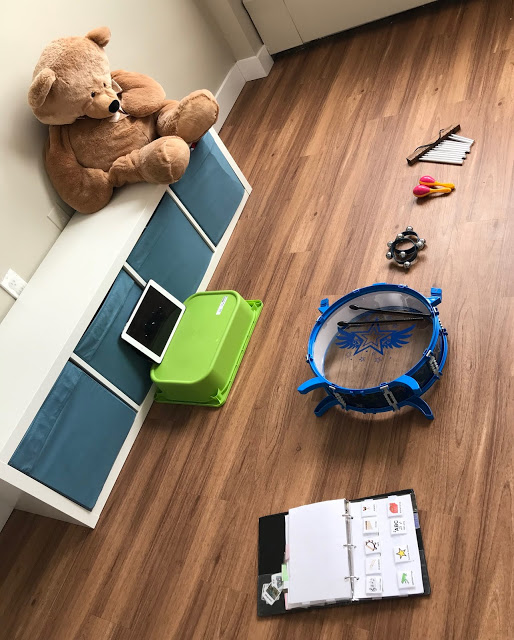
When online learning started in March, I shared on Instagram how I was having a hard time finding a reflection of our reality as I scrolled through my feed. Seven weeks later, it’s almost weird to feel like this is our norm. Mornings spent getting through showers, laying out uniforms, making lunches, updating communication books and filling up backpacks have been exchanged for a much slower pace. We’ve settled into our new routine which includes zoom sessions and tele-therapy. While N is able to (for the most part) sit and participate in virtual circle time and lessons with his class multiple times per day, the photo above is what online learning looks like for Y.For the past three years, he has received intensive therapy through the autism program offered in his school. When the school closures were announced, my fears of regression grew exponentially. Without the necessary consistency required of his program, consistency we had done everything to maintain for the last 3+ years, I couldn’t see how regression would be avoidable. While the last five years of this journey has thrown multiple learning curves my way, learning how to advocate through a pandemic has definitely been one of the most interesting. M & I are very involved in Y’s programming and with all aspects of his therapy. With the school closures, we didn’t just have to adapt to the pandemic version of homeschooling, supporting our three children under six through a chaotic and confusing time, working from home and navigating our way through Pesach, basic errands, groceries and more, we also suddenly became stand-in therapists. Together we developed our own “Get Y Ready For Pesach” program! We used techniques and strategies we had learned over the years and began to fade out chametz and prepare for a three-day yuntif (where routines would be further changed out of their norm than they already had been). I’m so proud to say our preparation and “program” was successful! Y’s resiliency and ability to adapt is astounding.
Now that school is back in session so to speak, the above photo is what e-learning looks like in our home. It just so happens that Autism Awareness Month fell during quarantine. While the phrase, “If you’ve met one person with autism, you’ve met one person with autism,” stands true, I feel like it’s important to share what learning right now may look like for families like ours.
Basically from birth, Y has always responded to music. Although he was colicky, over time, certain songs and sounds began to soothe him. Over this past summer, Y’s ability to communicate really began to pick up. We would frequently hear back from his team about how attentive he was during his group music sessions as well as how he’d participate and was more willing to put into practice different strategies he was learning in other areas specifically during this therapy. M & I spoke about it and although we were concerned with how full his schedule already was, we decided to go ahead and add music therapy. I was very clear that I didn’t want this to be work for him. I didn’t want him to have a ton of expectations and I didn’t want the other therapies to overtly partner here, as they did in other areas. I wanted this to be a space where he could enjoy music and where it could soothe him and help him continue to put into practice everything he had been learning naturally and, for the most part, independently (or at least more so than we had seen in other forms of therapy). I wanted him to know that we had “heard” him, so to speak, and understood that music had an impact on him and that we wanted to embrace and encourage it!
I could not have anticipated the results we’ve seen. I’ve learned (and frequently been told) to remain realistic. It’s not a phrase I like, but it is something I’ve come to at least partially understand. I truly believe Y is capable of everything and anything and will always advocate as
such. When it came to music therapy I had two motives – I wanted him to be happy and feel heard. N can tell us that he likes certain activities and expresses his hobbies and interests clearly. I strongly felt that Y was attempting to do the same through his engagement with music and I wanted him to know we recognized that. Months later, not only does he absolutely love these sessions, but the following three words speak for themselves – he is thriving.
Quarantine has been HARD, don’t get me wrong. When you go from 36 hours of professional intensive therapy a week to almost nothing for 5+ weeks, it’s definitely a shock and challenge. Behaviours that had been addressed begin to emerge again and the fear of regression hangs overhead like an ominous cloud. Given all that, without quarantine I would never have attended or participated in a music therapy session the way I’ve been able to these past few weeks. It may seem an odd thing to be grateful for, but I am nonetheless.
We are beyond blessed to have an incredible therapist working with Y. Her patience, sensitivity, encouragement, warmth, and undeniable skill are extraordinary. Our family has known and loved her for years, but working with her directly through these sessions (and through a pandemic) has only further solidified how in awe we are of her. She has not only supported Y these past few weeks, she has provided me with endless amounts of hope, encouragement and kindness. I have cried during more than one session. I have been completely amazed at how motivating music is for my son. How through it he attempts to form words, how he is able to follow instructions, understand expectations, and participate appropriately and meaningfully. How he doesn’t want it to end and will work even harder those last few minutes to extend the session, even attempting to verbalize “more”. How he gets past the difficulty of working virtually and will connect with his music therapist through a screen. How he listens to her and will look right at her on that screen. How he has the freedom to make choices and guide the session through selection of instrument or song. I have watched my son flourish and thrive during these sessions.
I would be lying if I said it was without challenges. There are moments that are more difficult than others, but on the whole, it’s an undeniably positive experience for him and one which has effects that filter into so many other areas. Because of these sessions I know he understands his visuals, he knows that he is able to make choices and be heard through using them and he puts into practice taking turns, following instructions, understanding expectations and so much more!
Having Autism Awareness Month fall during quarantine this year highlighted so much for me personally. Regardless of the fact that we’ve been helping our son navigate this journey for the last 5 years, being able to see his resilience has been inspiring and has taught me so much. Being able to attend his virtual therapy sessions has been so eye opening, both in terms of how hard he works and how much prouder I am of him and every single one of his results, seeing the effort and determination first hand. Usually I feel like this month is reserved for sharing awareness with friends, family and across social media, but given the circumstances this year, I’m the one who, over the past month, has gained the most awareness in so many ways – ways that I hope will better shape the way I not only relate to my son but also to his therapy going forward! It’s one thing to be on top of the therapy and communicate with the team, attend meetings, request and view data, adjust programming here and there or attend parent training or host in-home sessions. It’s something else altogether to help carry out a session, to witness his resilience, determination, and ability to adapt and work through regardless of the chaos and upheaval to his routine, schedule and structure. Each day I say I couldn’t be more proud, but that’s quickly disproved the next day as my pride only continues to grow! Virtual learning is by no means easy for our family, but we’re adapting where we can, advocating for alternatives where we can’t, and learning more about each other and our strengths than ever before. And while it’s not the Autism Awareness post I was planning to write this year, it couldn’t be more fitting. Potential, capability and resiliency through determination are three concepts that should be synonymous with our son’s diagnosis and, if nothing else, I hope that is what you’re able to take from this post and what I’ve shared today!
 victoriarosenberg.com